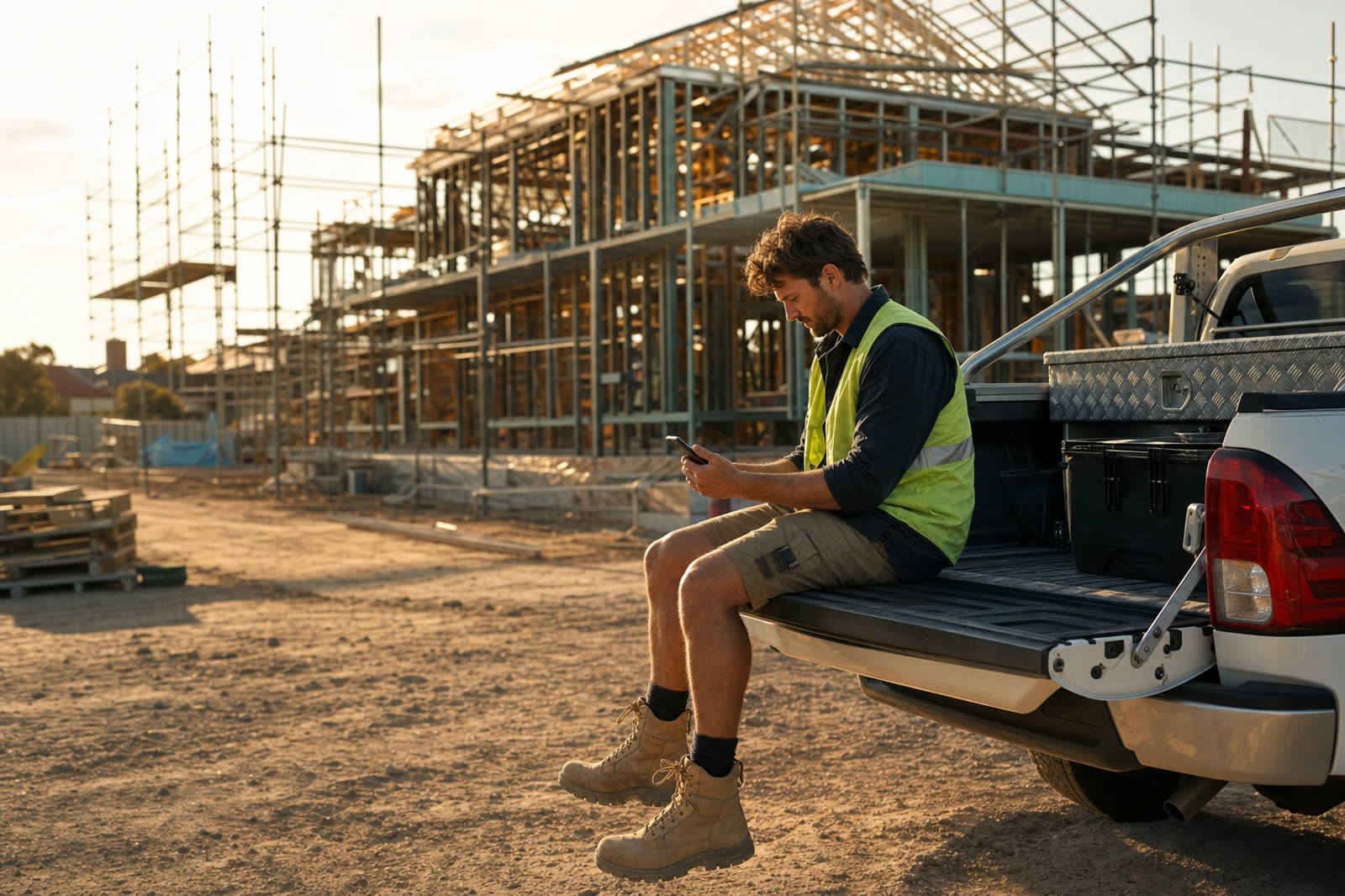
A Safe Work Method Statement is not a form. It is the plan for keeping a specific crew alive on a specific job. Under the WHS Regulations, if you're doing High Risk Construction Work in Australia, you must have a SWMS in place before the work starts. The 18 categories of High Risk Construction Work — HRCW — are spelled out in clause 291 of the model WHS Regulations, and they cover everything from working at heights above two metres to tilt-up construction, powered mobile plant, live electrical work, and demolition of structural elements.
The regulator does not care what template you used. The regulator cares that the SWMS is your SWMS, describing your crew, doing your task, with your hazards controlled. That's the whole game. This guide walks through what the WHS Regulations actually require, what the principal contractor will check first, and how to write a SWMS that keeps everyone — regulator, head contractor, crew — on the same page.
What a SWMS must contain
Every SWMS under the model WHS Regulations has four essential sections. Get these four right and the paperwork is legally sufficient. Get them wrong and no amount of formatting will save you.
- 1The high-risk construction work being done. Which HRCW category (or categories) applies, and a plain description of the actual task. Not "electrical work" — "chasing walls for 20 GPOs on the second-floor tenancy fit-out."
- 2The hazards and risks. The specific things that could hurt someone doing this task, at this site, today. Generic hazards — "electricity is dangerous" — do not count. Live conductors in a wall cavity behind old plaster do.
- 3The control measures. The specific things the crew will do to remove or reduce each hazard. Isolation, testing before touching, PPE, exclusion zones, supervision, permits. One control per hazard, at minimum.
- 4How the controls will be monitored and reviewed. Who checks that the controls are actually in place, when, and what happens if something changes on site. This is the section most SWMS get lazy on.
On top of those four, the SWMS must name the person who prepared it, the person or people supervising the work, and the workers who've been consulted about it. Consultation is a legal obligation, not a courtesy. If the crew hasn't seen the SWMS, it isn't the crew's SWMS.
The 18 HRCW categories, briefly
Clause 291 of the model WHS Regulations lists 18 categories of High Risk Construction Work. If any part of your job falls into one of them, you need a SWMS. The categories cover:
- Risk of a fall from more than two metres
- Work on telecommunications towers
- Demolition of load-bearing or structural elements
- Work involving disturbance of asbestos
- Structural alterations requiring temporary support
- Confined spaces
- Trenches or shafts deeper than 1.5 metres
- Tunnels
- Use of explosives
- Work near pressurised gas or fluid mains
- Work on or near chemical, fuel, or refrigerant lines
- Work on or near energised electrical installations
- Work in an area that may have a contaminated atmosphere
- Tilt-up or precast concrete
- Work on, in, or adjacent to a road or railway used by traffic
- Powered mobile plant
- Artificial extremes of temperature
- Work in, over, or adjacent to water where drowning is a risk
Some jobs trip two, three, or four categories at once. A roofer on a two-storey pitch might be looking at working at heights, powered mobile plant (for the scissor lift), and artificial temperature extremes on a 38°C summer day. The SWMS covers all of them.
A worked example: the sparky on a fit-out
To make this concrete, here's a common one. A sole-trader electrician is chasing walls for 20 GPOs on a second-floor commercial fit-out. The old plaster is coming off in sheets. There's no scaffold — she's on a step platform. What HRCW categories apply?
At least two: work on or near energised electrical installations (until the circuit is isolated and tested dead) and risk of a fall of more than two metres (once she's on the platform in a two-storey shell). Possibly a third — disturbance of asbestos — if the building is pre-2004 and the plaster hasn't been cleared.
A good SWMS for this job names all three. It says how the circuit will be isolated (lockout tag, testing after disconnection, retest at each new GPO location). It says how the fall risk is controlled (platform inspected before use, three points of contact, no reaching above head-height with tools). It says how the asbestos risk is controlled (pre-2004 building has had a clearance certificate; work stops if anything looks like non-friable ACM). And it says who's checking each of those controls — the sparky herself, at the start of the shift and after every meal break.
That's what site-specific means. The template she started from might have been generic. The document she signed on is not.
What the principal contractor will check first
When a head contractor asks for the SWMS at the site gate, they're checking three things in the first thirty seconds. Is the task described in a way that matches what they've engaged you to do. Are the HRCW categories they know apply — from the scope of works and the site conditions — reflected in the document. And is the SWMS dated recently enough to plausibly represent this job, not a job from 2019.
A SWMS that says "electrical work" for the task and lists generic hazards will get sent back. A SWMS that names the specific fit-out, the specific floor, and the specific equipment is one that gets waved through. Version history matters here too. If site conditions change — the plaster turns out to have ACM, the scaffold arrives, the pour date shifts — the SWMS gets a new version, and the crew signs on the new one before starting.
Where most SWMS templates fall down
The failure mode is almost always the same. Someone downloads a Microsoft Word template. They change the trade name at the top. They leave the hazards section as a generic list — "electricity", "manual handling", "slips and trips". They tick some HRCW boxes without thinking about which ones apply to this job. They print it, sign it, and bring it to site.
That document is not a Safe Work Method Statement. It's a template with a name written on it. The person doing the work knows the actual hazards — they're the ones about to face them — but the template didn't give them room to say so. The regulator, the head contractor, and the crew all end up worse off.
The fix is to build the SWMS from the person on the tools outwards, not from the template inwards. That's why voice-first works better than form-first: talk about the job for 30 to 60 seconds, and the site-specific detail lands automatically. The template becomes the structure at the end, not the starting point at the beginning.
Retention and revisions
Under the model WHS Regulations, a SWMS must be retained for at least two years after the work covered by it is completed — and for at least two years after a notifiable incident, if the SWMS was relevant to it. In practice that means "keep them longer than you think you need to". Cloud storage is cheaper than a court date.
Every revision of a SWMS should be saved as a new version, not an overwrite. If the head contractor ever asks what the SWMS looked like on a specific date, you need to be able to show them — not the current version, the version that was current then.
How Sitepack handles all of this
Sitepack is built around the person on the tools. You describe the job in a 20-to-60-second voice memo — the crew, the task, the gear, the hazards — and Sitepack drafts a site-specific SWMS with the right HRCW categories flagged, the four required sections filled out, and a QR sign-on link for the crew. You review it on one screen, tick or untick anything, and get a PDF for the head contractor. Every revision is saved as a new version, kept for a minimum of two years, hosted in Sydney.
You still own the document. You still get final say. The regulator still holds you accountable — as they should. What Sitepack removes is the admin drag of fighting a Word template that was written for a job that isn't yours.
Ready to talk your first SWMS into existence? Free trial, no card, ten minutes to your first document. See how Voice-to-SWMS works →